
Kenya’s revenue collection currently stands at over Shillings 600 billion annually. This development has been occasioned by the structures put in place by the Kenya Revenue Authority that has in great ways been able to seal loopholes that tax evaders had utilised for a long time to deny government taxes.
Gauging from what the taxes have been able to achieve in the short span, it is a clear indication that Kenya can develop faster if it gets good stewards to steer the countries resources forward to greater economic development in line with vision 2030.
John Njiraini the current Kenya Revenue Authority boss was applauded recently when he stated that there was need for the Members of Parliament to pay taxes as they also expect Kenyans to do so.
Mr. Njiraini who was the then Commissioner for Domestic taxes stood his ground and despite resistance from the legislators, word was sent home that revenue collection in the country was serious business. Although the orders have not yet been fully implemented, Mr. Njiraini as the boss of KRA many will watch to see how he steers the organisation to greater heights.
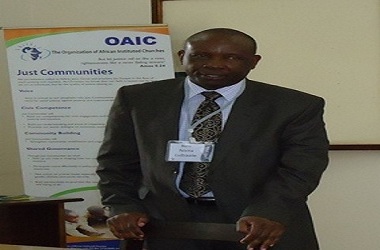
There is still however a notion by many people in Africa that donor funding may be the solution to the many problems that the continent is afflicted by. Reverend Nicta Lubaale, the General Secretary of OAIC states that it is high time people learnt to be self sufficient in the small resources they have rather than dependence on donor aid if any desirable development is to happen in the country and Africa as a whole.
“There is need for people to shift their mindsets from proposal writing and think about holding leaders accountable in their various departments for effective service delivery. The problem is that for a long time, people have had the notion that the Non – Governmental Organisations are the only viable institutions that can steer meaningful development in the various countries. That in order for development to be seen to happen, there must be an NGO involved. It is sad to note that many people still continue to concentrate on writing proposals and expect that money from donors will bring change yet the proposals could take up to a year or even more before the writers get a response. During this period, other developmental ventures could have been thought of by the writers,” states the Reverend.
He notes that revenue collected can be able to bring the change required as already envisioned in the country. He says that some of the developments that have been necessitated by taxes include the funding of the Free Primary Education which is 90% funded by the tax payers and a paltry 10% by the donors. The great infrastructural development currently seen throughout Kenya as well as the funding of the National budget are examples of what taxes if properly utilised can achieve.
Reverend Nicta who was addressing church leaders from Kenya, Tanzania and Uganda at a conference at CORAT – noted that self-provisioning is an issue that the church needs to start advocating for in order for people’s mind sets to be changed for the betterment of the society. He also notes that Harambee – fundraising – is not a bad thing but rather than write proposals, monitoring and evaluation of what the taxes are doing in their various allocation in government should be the core business of all stakeholders to ensure that the trustees are held accountable and this will ensure that proper service delivery in the country is seen to happen.
He notes that people have the power to solve their own problems and that the reasoning by a majority that Africa’s problems can only be solved by a white person is misplaced. “That just goes to show that our minds are still very much colonized. Only Africa will be able to sort out Africa, just as Asia will sort Asia. We see Brazil is sorting out Brazil. This country whose development record was also not perceived in line with the 1st world is now the 6th richest world. This shows that any country that focuses and puts its energy to deal with the issues that are stalling development can be able to achieve greatness,” he reiterated.
When people pay taxes, they expect effective service delivery. Thus it is up to the church and other stakeholders to work hand in hand to ensure that the taxes work for everyone as continuance dependence on the NGO’s to solve problems will only lead to stagnated development.
Building the foundation and ensuring that effective structures are put in place in government institutions will largely improve accountability and service delivery will be greatly improved.
The Reverend also pondered over the issue of Africa having the largest number of growing churches while in Europe and other parts of the world there are less churches and others even closing down and the irony of the situation is that they face less problems.
“They pray less and die less and why do we pray more and yet still more people die. Where is the problem? As a church we should not allow the rampant deaths. People should be able to live longer and enjoy life,” stated the Reverend.
Ignorance was also perceived largely as a factor that had impoverished many people and especially in the rural areas as many of the residents have been blamed for following religiously some indigenous churches which advocate for solutions that may be impracticable at times.
A Bishop from OAIC narrated how he had saved his mum as a teenager when she had been advised to deliver with the help of midwives. He says that the mid-wives tried to help her deliver but after long hours it became apparent that they were unable and she would need specialized treatment.
“The trouble with the women who were present is that they kept on saying that we should continue praying while it was apparent that the delivery was a complicated one. I was only 17 years old then, and considering that my father was working in Uganda I had a great responsibility in my hands. Lucky enough I was able to get a vehicle that helped transport my mother to the hospital after promising the owner that he would be paid after parting with the only cow in the homestead. She was lucky to survive however, the baby was dead by the time she was operated on,” narrated the bishop.
The Bishop was adamant that some churches had contributed to the impoverished lifestyles people were leading and especially the indigenous ones which were blamed for convincing their congregations that everything would work by prayer alone and not necessarily seeking medical attention.
Reverend Nicta states that in other countries like Botswana, many women also believe that if women give birth in the hands of the mid-wives, they are perceived as more blessed than the ones who give birth in the hospitals.
He wonders why in many parts of the world such situations are unheard of. “It’s sad to note that women still largely give birth at home with the help of the birth attendants. In Tanzania reports indicate that 46% of births are under the birth attendants. In Uganda, 41% while in Kenya 42% still give birth under the mid-wives. At least 40% of the children across the region are stunted due to lack of proper food, malnutrition and other causes,” noted the Reverend.
Many participants in the conference concurred with the assertions as some gave reports of people who had succumbed to chronic illnesses like cancer while their pastors kept on encouraging them to pray rather than seek medical attention. However, a church leader from Tanzania was of the view that God can heal as He had experienced His healing power on a personal level. He gave a testimony of his son who had had convulsions throughout the night and was in a bad state and in the morning, the child was taken to a prayer centre and was healed.
Reverend Nicta was however careful to note that people should always be able to make decisions and make clear judgements as to when to take someone to hospital and when prayers may seem to work but stated that prayer cannot be depended upon as an end in itself.
In the advocacy conference whose main aim was to train and brainstorm as well as educate the leaders on how they can effectively demand for proper service delivery in their various countries, Reverend Nicta noted that for advocacy to e effective, there was the need for the church to mobilize people not only to pray but also to deal with the root causes of the sufferings in society.
Some of the challenges still facing the sub-Saharan region was the health sector as medical personnel are very few, overstretched and underpaid which has led to the recent strikes we have seen in the country. In Uganda for instance, for every 25,000 people, only one doctor is in charge. That means there are people in their lifetime who have never seen a doctor which is a sad state of affairs.
The Reverend urged the church which has lately lost its flavour to rise up and evaluate its role in society by taking responsibility and speaking prophetically and ensure that they remain the salt of the earth.
By: Fiona Imbali OAIC Communications
About the Author


